
Tippecanoe County Arrest Records and Charges
Arrest records usually begin with law enforcement or jail activity: arresting agency, booking number, arrest number, booking date, custody status, bond, and related charge labels where the jail roster exposes them. Tippecanoe County's official jail path is the Sheriff-linked JailTracker roster, and the client model includes booking, arrest, charge, bond, court, warrant, and release fields. Those fields are custody-side data, not the final court case file.
Court charges after arrest begin when the Tippecanoe County Prosecutor files the formal accusation in court. The charge record is tracked in MyCase with the case number, court, defendant, charge description, offense statute, offense date, offense degree, citation number, bond, events, hearings, disposition, and modifications. Booking detail belongs with jail records, while the complete court outcome belongs in Tippecanoe County criminal court records.
Find Tippecanoe County Arrest Records
The charge side is searched in Indiana MyCase. Use By Party or By Case, choose Tippecanoe County, and select Criminal and Citation when narrowing results. If the incident involved a city-court citation, check the Tippecanoe County - West Lafayette City Court option. Jail custody or current booking details are separate and should be checked through the county-linked JailTracker roster or Sheriff contact channels.
- Search MyCase by defendant name, case number, citation number, or cross-reference number.
- Open the criminal or citation case and review the charge list before reading the full docket.
- Check each charge's offense statute, degree, offense date, citation number, and modification field.
- Use bond, court date, and disposition entries to see whether the case is pending or resolved.
- Use Sheriff or jail channels only for custody, booking, release, and current inmate questions.
The Prosecutor's official sources can explain active initiatives and case outcomes, but a specific person's filed charges should be verified in the court record. The Tippecanoe County Prosecutor community-news category is one successful manifest source for prosecutor activity connected to arrest and charge topics.

That source belongs here because prosecutor review is the step that turns arrest allegations into filed court charges after arrest.
Tippecanoe Charges Filed After Arrest
A person can be arrested before every court count is final. The prosecutor reviews police reports, available evidence, and the law, then files or declines charges. The charge record starts when the accusation is filed in court, not when a person is merely booked into jail. In Tippecanoe County, those filed charges can appear in MyCase with statute, degree, offense date, charge description, and later modifications.
| Complaint | Information | Indictment | |
|---|---|---|---|
| Who Starts It | Officer or prosecutor, depending on the case path | Prosecutor | Grand jury |
| Common Use | Early criminal allegations and some lower-level filings | Many felony or misdemeanor prosecutions filed by the State | Serious matters when grand-jury process is used |
| What It Does | States alleged facts and charge basis | Lists formal charges filed by the prosecutor | Returns formal charges through grand-jury action |
| Where It Appears | MyCase docket or Clerk file if public | MyCase charge record or Clerk file if public | MyCase or court file when public and not sealed |
Tippecanoe Court Charge Status
Charge status can change many times before the case ends. One arrest can produce several counts, and each count may have a different path. A charge may stay pending, be amended to a different statute, be reduced to a lower level, be dismissed, or end in a conviction. Read the charge list with the docket events and disposition entries because the status field alone may not explain the whole case history.
| Status | What It Means |
|---|---|
| Pending | The charge remains active and no final outcome has been entered for that count. |
| Amended | The prosecutor or court changed the charge description, statute, level, or count details. |
| Reduced | The charge changed to a lower offense level or lesser count, often through plea or review. |
| Dismissed | The court record shows the count was dismissed rather than ending in conviction. |
| Nolle Prosequi | The prosecution declines to proceed on a charge, where that terminology appears. |
| Disposed | An outcome has been entered, but the specific disposition should still be read for each count. |
Note: Read every count separately because one arrest can produce multiple charges with different outcomes.
Tippecanoe Court Charge Fields
Tippecanoe charge records draw from both court and custody systems, but those systems are not the same. MyCase is the court source for filed charge information. JailTracker is the custody source for current inmate and booking details. The research found that the JailTracker client model includes charge description, arrest code, crime type, court type, offense date, court date, case number, control number, warrant number, modifier, bond amount, bond type, counts, and charge status, but live rows were not captured for every field.
| Field | What It Shows |
|---|---|
| Charge Description | The plain charge label or alleged offense name. |
| Offense Statute | The Indiana law section tied to the count when shown in MyCase. |
| Offense Degree | The felony, misdemeanor, infraction, or other level used by the court record. |
| Offense Date | The alleged date of the incident or offense. |
| Citation Number | The citation identifier when the charge began through a citation or ticket. |
| Bond Amount | The bond figure tied to custody or release when public. |
| Court Date | The next or related court event in the charge or case path. |
| Charge Status | Whether the charge is pending, modified, disposed, dismissed, or otherwise updated. |
Tippecanoe Charges vs Convictions
An arrest and a filed charge are not convictions. A charge is an accusation placed in court after prosecutor review. A conviction is a later outcome based on a guilty plea, guilty finding, or verdict. Tippecanoe County arrest records may show a person was booked, and court charges may show the filed counts, but the disposition and sentence determine whether any count became a conviction.
| Charge | Conviction | |
|---|---|---|
| Stage | After arrest, citation, or prosecutor review | After plea, finding, or verdict |
| Meaning | Accusation filed in court | Legal finding or admission of guilt |
| Record Clue | Charge list, statute, degree, count, bond, and court date | Disposition, judgment, sentence, probation, fines, or costs |
| Can Be Removed From Public View | May qualify for sealing or expungement if eligible | May qualify for Indiana expungement if statutory requirements are met |
Tippecanoe Sealed and Expunged Charges
Indiana Code 35-38-9 governs sealing and expungement of eligible arrests, charges, and convictions. Tippecanoe local rules add filing paths. If charges were filed, non-conviction petitions generally go to the court where the charges were filed under a new XP cause without court costs. If no charges were filed, or if multiple courts are involved, the petition is filed in Superior Court 2 under a new XP cause without court costs. Conviction expungement filings usually go to the court of conviction.
| Sealed | Expunged | |
|---|---|---|
| Public Access | Hidden or restricted from ordinary public search | Restricted, marked, or limited under Indiana expungement law |
| Common Trigger | Court order, statutory exclusion, or protected record category | Eligible arrest, charge, non-conviction, or conviction petition |
| Local Filing Point | Depends on the case and order | Court of charge, court of conviction, or Superior Court 2 in specific local-rule situations |
| Remaining Limits | Authorized users may still have limited access | Does not necessarily erase every outside reference or national repository entry |
Tippecanoe Charge Codes and Severity
Charge codes and severity levels tie a court charge to a statute and offense class. MyCase can show offense statute, offense degree, offense modification, original offense degree, citation number, offense date, and charge description. In Tippecanoe County, Superior Court 6 handles traffic infractions, OWI, and many motor-vehicle criminal cases, while Superior Court 7 handles some misdemeanor operating-while-suspended cases and other hybrid assignments. Major felony charges may route to Circuit Court, Superior Court 1, or Superior Court 2.
Severity affects the case path, but it should not be read from one label alone. A Level 6 felony, misdemeanor, infraction, or traffic offense may be amended or reduced, and multiple counts can appear in one court case. The docket and disposition show whether a charge remained pending, was dismissed, was reduced, or ended in conviction. The jail roster may show a charge label before the final court outcome exists.
Tippecanoe Arrest Charge Access Limits
Indiana Rule 5 excludes some records and fields from public access. That matters for Tippecanoe County arrest records and charges after arrest because a public search may not show juvenile details, sealed charges, mental-health-related records, protected identifiers, victim and witness contact details, or certain warrant-related records before arrest. Rule 9 provides the procedure for seeking excluded court records when access is legally available.
The Rule 5 source is one of the successful manifest images for this page. The Indiana Rule 5 exclusions from public access explain why some Tippecanoe County arrest records or court charge fields do not appear publicly.
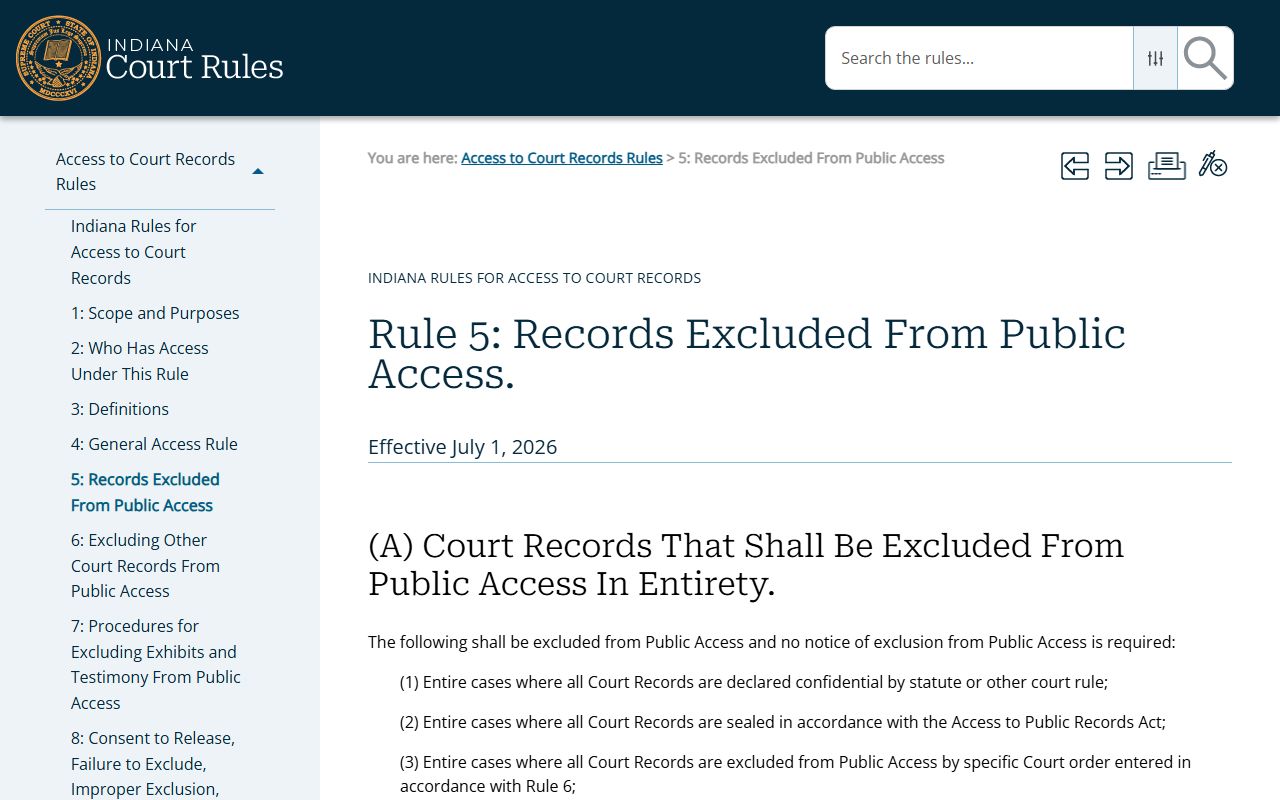
That rule source belongs with arrest and charge searches because excluded fields can make a public case look incomplete.
Rule 9 explains the process for requesting excluded records in limited situations. The Indiana Rule 9 access procedure is relevant when a Tippecanoe County court charge record is withheld or redacted.
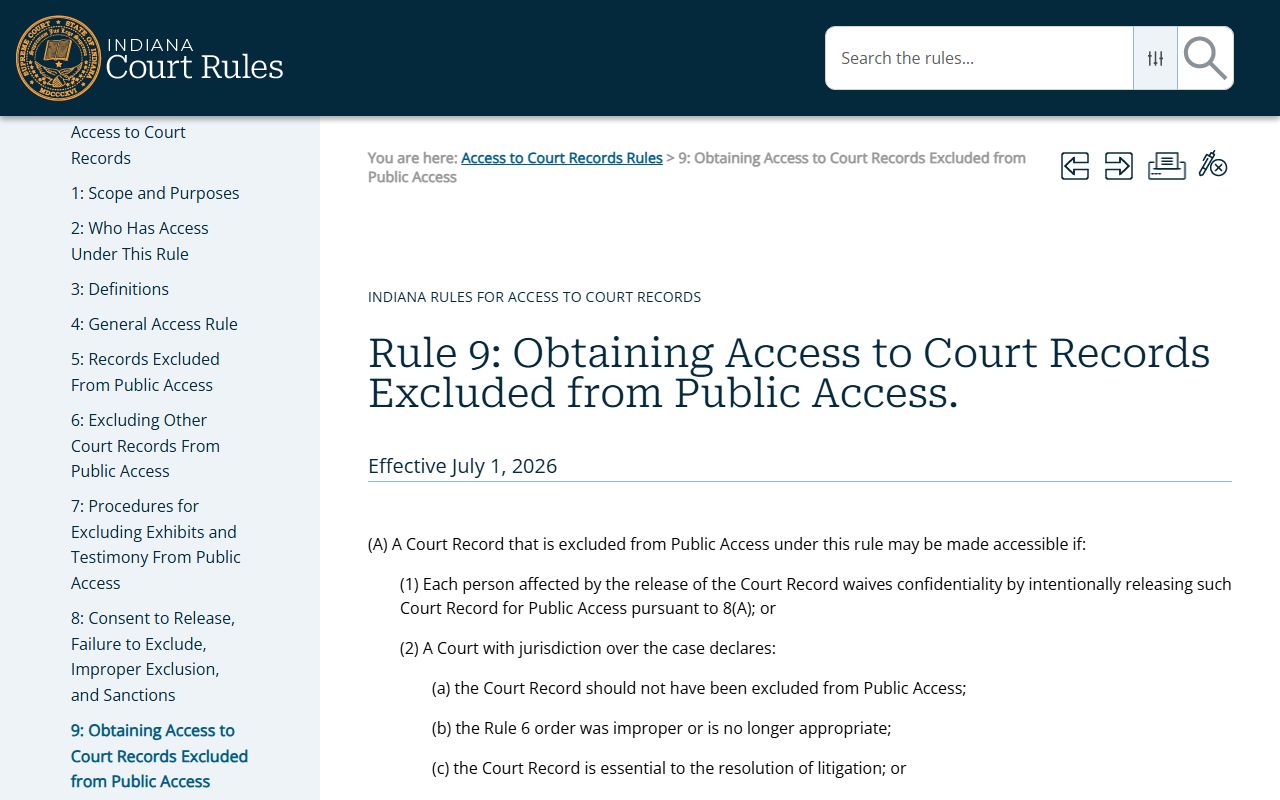
Rule 9 is not a shortcut around confidentiality, but it identifies the formal court path for excluded-record access requests.
Tippecanoe Juvenile Arrest and Charge Records
Juvenile records require special caution. Tippecanoe Superior Court 3 handles nearly all juvenile matters, and local rules route juvenile delinquency and CHINS expungement petitions to Superior Court 3. Indiana's juvenile-record framework does not treat all juvenile court records as ordinary adult public records. Access may require statutory authorization, court discretion, or a court order.
Arrest or charge information involving minors may be restricted even when a similar adult charge would be searchable. The Indiana juvenile-record access framework is the successful manifest source for juvenile limits on Tippecanoe County arrest records and court charges.
The juvenile source is included because public charge searches should not imply that juvenile arrest or delinquency details are fully open.
Prosecutor and Public Defender
The Tippecanoe County Prosecutor files charges on behalf of the State of Indiana. The office is at 111 N. 4th Street, 2nd Floor, Lafayette, IN 47901, with phone 765-423-9305 and email prosecutor@tippecanoe.in.gov. The prosecutor decides which formal counts to file after review, and later court records may show amendments, reductions, dismissals, plea agreements, or sentence recommendations.
The Public Defender's Office represents indigent clients appointed by the courts in adult criminal charges, juvenile criminal charges, juvenile status offenses, probation violations, and other appointed cases. It is not the place to request arrest records or copies of charges. Request records through MyCase, the Clerk, or the Sheriff depending on whether the need is court charges, certified case copies, or custody records.
Important: A public arrest or charge lookup is not a consumer report and should not be used as a formal background check.